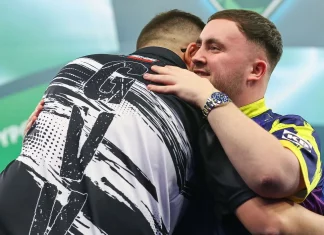
Luke Littler’s Second UK Open Title: A Dominant Force in Darts
A second consecutive UK Open title for Luke Littler has once again left the darts community in awe. While many celebrate the young world champion’s incredible talent, not everyone is basking in pure admiration. In a recent episode of the podcast Darts Draait Door, former professional darts player Vincent van der Voort voiced his concerns about the competition Littler faces from the elite players. He argues that the issue doesn’t lie with Littler’s performance itself, but rather with the lack of pressure exerted by his opponents.
Critics’ Voices: Assessing the Competition
Van der Voort watched Littler dominate throughout the tournament with a sense of disappointment. “Yeah, nice, isn’t it? I’m getting a bit fed up with it now,” he remarked. His frustration doesn’t stem from Littler’s skill, but rather from observing how top-tier players seem to falter under pressure when matched against him. “None of them play their best match against him,” he noted, which raises concerns about the competitive landscape in professional darts.
The Dutchman pointed out a noteworthy trend: many seasoned players seem to underperform when facing Littler. Van der Voort speculated that perhaps they mentally concede defeat before the match even begins. “You should at least feel he’s being pushed to the limit. And if he’s still better, fine. But he doesn’t even have to play that well to win,” he emphasized.
The Flaws of Top Players
Several matches during the UK Open highlighted this sentiment. One such case was Gary Anderson, who, despite a strong showing throughout the tournament, failed to deliver when it mattered most. Van der Voort critiqued, “He really wasn’t at his best. They didn’t show up.” This underscores a troubling notion: when elite players fail to rise to the occasion, it diminishes the competitive edge and excitement that the sport thrives on.
Gerwyn Price was mentioned as a rare exception to this pattern. Van der Voort praised Price’s unwavering desire to win at all costs. “We need more players like that,” he asserted. For the sport to grow, it seems that a shift in mindset is imperative.
The Dutch Challenge: Missed Opportunities
When it comes to challenging Littler, the Dutch players perhaps came the closest, but still left room for improvement. Kevin Doets and Danny Noppert had moments when they kept pace with Littler, yet failed to capitalize on critical junctures. Van der Voort noted the importance of maintaining momentum: “Doets should have pulled further ahead early on.” The pressure of the moment seemed to weigh heavily on them, leading to a missed opportunity to topple the champion.
Noppert’s performance was similarly frustrating, as he experienced a crucial blow during key moments. After getting hit with a 161 finish while sitting on 25 points, the game turned in Littler’s favor once more. “Those are the moments when Littler is brilliant,” Van der Voort explained. It’s not merely about performance; it’s about seizing those fleeting chances.
A Mixed Bag: Littler’s Performance
What is perhaps most striking is Van der Voort’s assertion that Littler didn’t even showcase his top form during the tournament. “He wasn’t even brilliant this tournament,” he commented, stating that this makes his dominance all the more alarming for competitors. “He still wins when others fail to bring their best game against him,” he reiterated.
An interesting aspect of Littler’s game is his composure during rough patches. Van der Voort highlighted how, even when struggling with doubles—registering a low percentage—Littler remains calm and continues to execute his throws consistently. “That’s a textbook example for anyone who plays darts,” Van der Voort noted, underscoring the difficulty of maintaining composure under pressure.
Near Misses: The Case of Josh Rock
Josh Rock, another player who presented a viable challenge, also found himself unable to capitalize on opportunities against Littler. While he led at one point, he allowed the momentum to slip away. Van der Voort pointed out the significance of maintaining focus and execution during crucial moments: “When the chances are there, he doesn’t take them.”
In contrast, James Wade emerged as a standout competitor throughout the tournament. His scoring prowess was undeniable, pushing him into the final where he faced Littler. Van der Voort noted Wade’s exceptional performance in earlier rounds, indicating his capability to perform at a high level consistently.
Shifting Dynamics in the Ranking
As the competitive balance shifts, Van der Voort emphasized that established players are becoming increasingly vulnerable. With Wade climbing and Price making a resurgence, it’s evident that players like Michael van Gerwen may need to take heed. The former professional warned that Van Gerwen could find himself in a precarious position if he doesn’t perform consistently. “If he doesn’t perform, he drops,” Van der Voort cautioned.
Understanding these dynamics is crucial for players and fans alike, as the world of darts continues to evolve. As Littler maintains his dominance, the pressing question remains: will the elite players step up to the challenge?
The evolution of competitive darts is in motion, and the spotlight is firmly fixed on both the rising stars and the seasoned veterans. While Littler continues to dazzle, the onus now lies with his opponents to meet and exceed expectations, creating a thrilling narrative for darts aficionados around the globe.